
Price and product
How to Price Desserts: Cost vs. Price for Bakers
The pastry chef who is afraid to name a price
Do you know what I see most often? A pastry chef makes an incredible confection—with skilled hands, a delicate flavor, and lively decoration—and then freezes when someone asks, “How much does it cost?” They start pulling the price out of thin air. They glance at the ceiling, think, “Well, probably a hundred,” and scare themselves: what if it’s too expensive, what if nobody buys it? So they set it lower. Then lower again. Until they reach a figure that calms them down a little, but does not even cover what they spent.
I have been selling high-priced products for a very long time. And this question—how to work out cost, cost-plus price, and price—came up for me many years ago, in a large business. So today I want to take this seriously, right from the beginning. We are not going to get tangled up in terms. We will simply lay out, step by step, what cost is, what cost-plus price is, what price is, where they overlap—and why, until you understand this, you lose money for no good reason.
Take a pen and some paper. This is one of those times when it is better to write things down.
Three concepts are a ladder, not synonyms
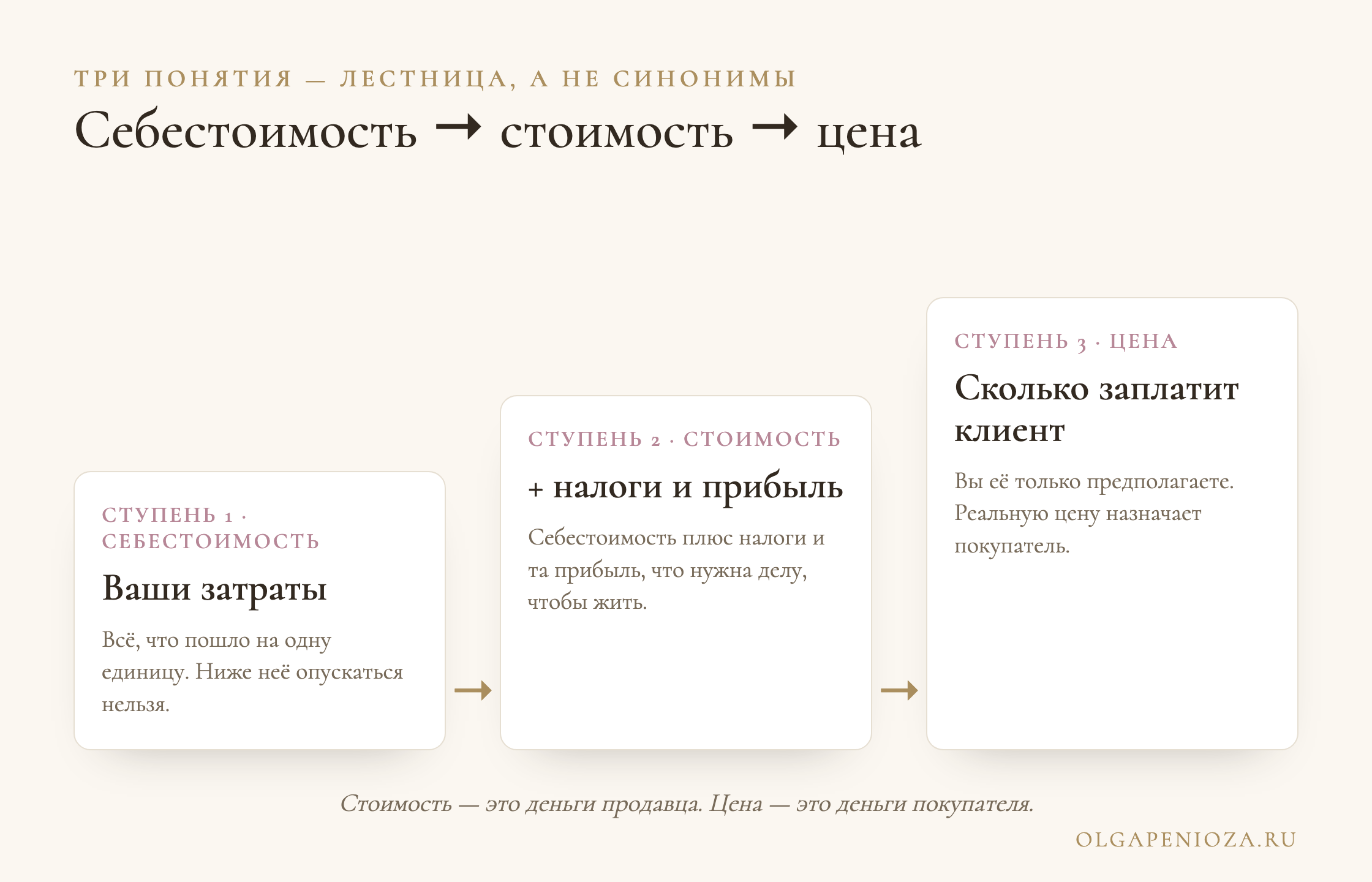
The first thing to get firmly in your head is this: cost, cost-plus price, and price are different concepts, but they are very closely connected. And they are connected in order, like steps:
- cost-plus price is calculated from cost;
- price is based on cost-plus price.
Let’s take each step in my own words, the way I always explain it.
Cost is your expenses. The expenses of the person who produces, makes, and sells, for one unit of product. One confection. The cost of one confection is the simplest, most straightforward of the three concepts. And at the same time, it is the most basic: nothing else can be calculated without it.
Cost-plus price is cost plus a markup. The markup is made up of the taxes you have to pay and the profit your business needs in order to keep moving, developing, and staying afloat. Write it this way: cost-plus price is cost plus taxes plus the money your business needs to stay alive.
Only after that does price appear. And this is the most important thing that many people skip. If you think the price of your product is simply whatever you name, I have to disappoint you: that is not quite right. The price of a product is the amount the customer is willing to pay for it. The customer is willing. You are not forcing this price on them. You can name any high figure you like—no problem. But the real price, the actual money for your product, is set and paid by the customer.
You only estimate the price. You make an offer based on calculating your cost, calculating your cost-plus price, and looking at the market around you. But the final price is paid by a specific person. And if you compete only on price, that amount may turn out to be much lower than you would like—the customer will pay only after a discount. The opposite can happen too: the price in someone’s head may be noticeably higher than the timid price you set for yourself.
Write this in red ink—I never get tired of repeating it: cost-plus price is the seller’s money. It was tied up in obtaining and creating the product. Price is the buyer’s money. It is not your money until they hand it to you. Cost-plus price is already in your past; you have already incurred it. Price is your future, only assumed income.
Cost: why you need to count it down to the last penny
Cost is the total of all types of expenses you incur while making your confection. And it is the figure that sets the minimum price: the number below which you simply cannot fall, or you go into the red.
What do we include? Take this down:
- materials—everything that went inside the confection;
- electricity;
- depreciation of fixed assets—you have an expensive oven, and it ages and wears out; that wear is part of the cost too;
- labor costs—how much time and work a person put in to make this one confection;
- overheads.
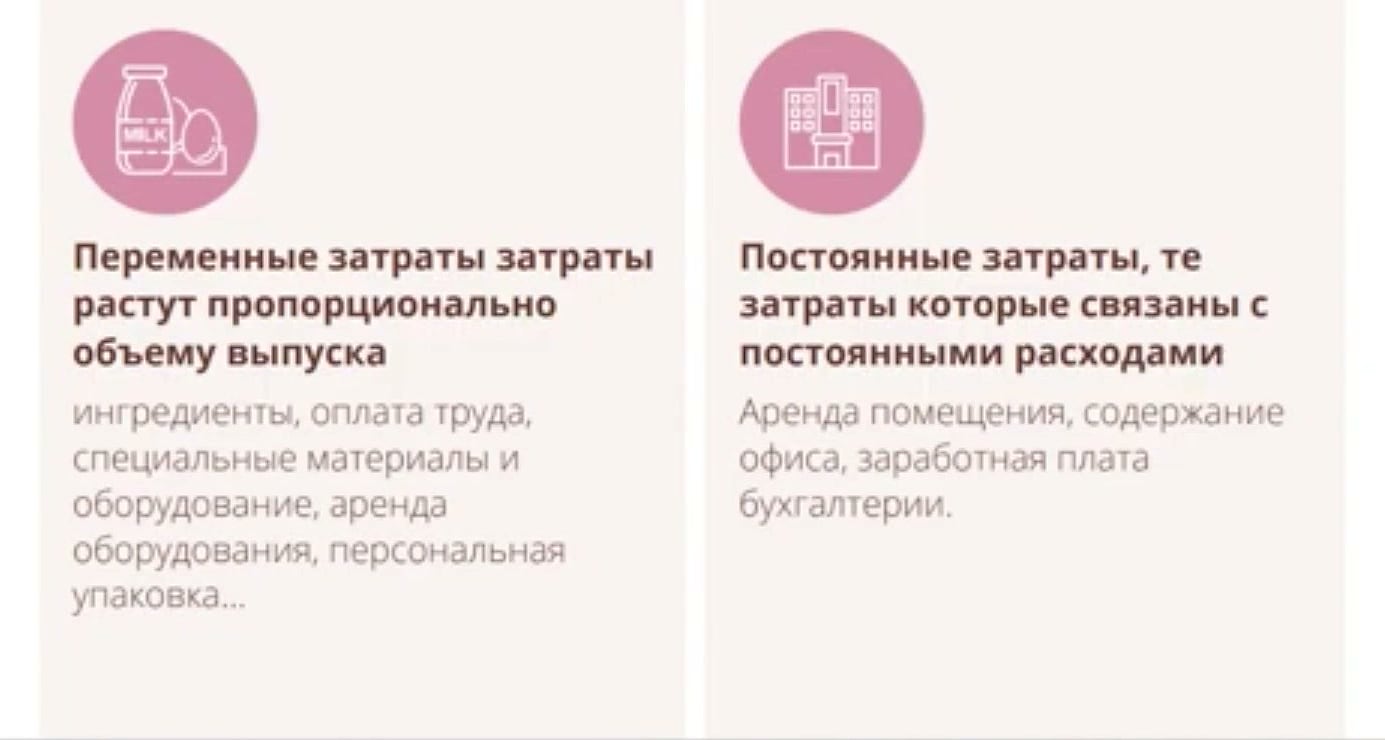
Next, I divide expenses into two groups. Variable costs grow in proportion to the number of confections: ingredients, individual packaging, guitar sheets, chocolate transfers—one box for three confections and, say, 12 grams of chocolate for the shell, while ten confections need three packages and three times as much chocolate (the figures here are just my example to show the logic). Fixed costs barely depend on quantity: rent, a manager’s or accountant’s salary—you pay it whether you made one confection today or a hundred.
Why count all this? Because knowing your cost is the first step toward profit. If you do not know it, you will never move toward profit at all—you simply will not understand what is built into it or where you can shift something.
And once you break your cost down to its smallest parts, you start to see where you can really reduce expenses without losing quality. My favorite example is substitutes. Take nut paste. Real paste costs more than a substitute, one hundred percent. But to get the same vivid flavor from a substitute, you have to put noticeably more of it into the confection. In the end, a confection made with a “cheap” substitute costs you more than one made with expensive but honest paste. Substitutes almost always hide a catch. This does not mean “never buy anything cheap”—it means: calculate, make a conscious decision, and do not stumble into one by accident.
The same applies to hidden limitations that you may not see in advance at all. Sometimes a particular colorant that makes it easy to get the shade you need is simply not approved for use in a particular country—and you have to look for a replacement, which costs time and money. Or your delicate filling lasts only 72 hours in the refrigerator (again, this is just my example), which means this confection physically cannot be sold from a marketplace warehouse. All of this is part of your cost structure, and it is better to learn it at the planning stage than after you have already made everything.
How an expense turns into a reason for the price
Now for the most interesting part. Take your complete list of expenses and go through every item with one question: can this expense be transformed into value? Why is it important to do this? Because the price you set is a bundle of values. Bread starts selling for hundreds only when it is surrounded by the effect of value. With confectionery, you can certainly do this.
Look at how it works in real-life examples.
Delivery. It may seem like time wasted from your own day, something you could hand over to a courier. But there are situations when personal delivery by the maker is seen as a special mark of respect for the customer. I know many people who run pastry businesses where delivery by the chef adds an extra 20 percent to the price. And people are willing: they want to see the person who made it and pay for the fact that they brought it themselves.
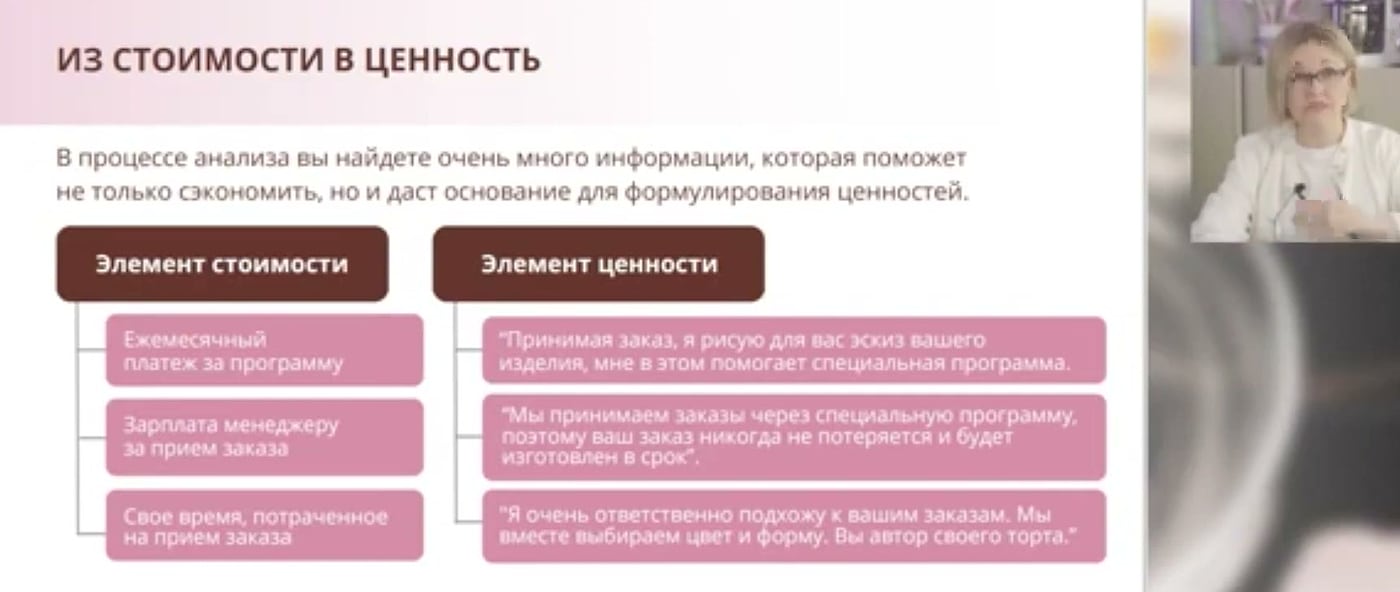
A sketch. Yes, it means extra spending on software, your time, and responsibility—what if it does not turn out exactly right? But what do you get in return? A sketch frees the customer from the unconscious images in their head, images you may not even know about. We once had a wedding client who kept saying right up to the end that the dress was turquoise—until we asked her to bring in a piece of fabric. It turned out to be emerald. Can you imagine what would have happened if a turquoise cake had arrived instead of an emerald one? A sketch calms the customer down. And when I say, “I am drawing a sketch for you; together we choose the color and shape—you are the author of your confection,” the person develops a feeling of involvement. Few people do this—and you stand out immediately.
A story. This means extra spending on the card itself and time to come up with it. But a story is what turns your confection from just a confection into a beauty’s smile. This is a different perceived value. It is a story you put into the customer’s mouth, so they can explain to themselves and others why they bought this confection for a hundred each when a kilogram in a store costs three or four hundred.
And even with items that do not seem connected to value at first glance, do not rush to throw them out. Take taxes. They look like a purely expense-side item, just another cost of yours. But here is what the women in the chat themselves pointed out: we issue receipts—so the production is professional. If I pay taxes, I am a responsible person, I work officially, and that is already about trust. It turns out that even a tax can be turned into an argument the customer believes.
Behind every phrase like “we will deliver it ourselves,” “you are the author of your confection,” and “your order will never be lost” stands a consciously calculated element of your expenses. It no longer sits silently in the cost; now it works for the price.
Value is emotion. A product is an impression in the customer’s hands
Now we have reached the reason for doing all this. Value is the emotional component. Always.
Remember the fairy-tale apple that keeps you young. Its value is not in the cost of the fertilizer used to grow the tree. Its value is that the person is emotionally happy—they will always be young. It is the same with confections. Value is not the amount of ingredients you loaded inside. Value appears when the person experiences an emotional lift as they receive your confections.
And the value of the same product will be completely different for different customers. For one person, the apple that keeps you young is priceless, while for a teenager it means nothing. That is why different people will set different prices for the same product. This is exactly why cost can be low and price high—because the perceived value is high for the customer. And the opposite is true: huge investment, high cost, but low value—and a low price.
Here I want you to hear the main idea very clearly. The product is not the confection. The product is the element the customer holds in their hands and the emotions they experience at the same time. If your product is meant to stand in a box, then the product is the confection, the box, the way it sits next to the other confections, and the bag in which it all gets home. The product is the entire experience.
And like magicians, you can create this aura, this halo of value around your product. What is more, when the customer becomes a co-author—through a sketch, through a story—they begin to treat your confection differently. It passes through their soul, through their emotions. And then they talk about it with such delight that they effectively become your salesperson—on their own, for free, creating that very halo of value for you.
What to remember
Let’s gather everything into a short chain so it stays on paper:
- Three concepts are a ladder. Cost → cost-plus price → price. Cost-plus price is calculated from cost, and price is based on cost-plus price. Do not skip the steps.
- Cost is your expense per unit. You need to know it down to the last penny: it is the minimum price below which you cannot go, and the first step toward profit.
- Cost-plus price is the seller’s money. Price is the buyer’s money. You estimate the price, but the customer pays it. They determine the level of your price, including in relation to the whole market.
- The price you set is a bundle of values. Go through each of your expenses and ask: can I turn it into value? Delivery, a sketch, a story, even a receipt and a tax—all of this can become a reason for the price.
- Value is emotion. A product is not a confection but an impression in the customer’s hands. Count everything. Then you will not just learn the cost of your products—you will truly begin to value your own work.
Count it all. Whatever the size of your business—even if you make confections just for home, for your family—keep track of it. It will help you a lot, including in how you feel about your own value.