
Method
How a Professional Reads a Recipe: A System, Not a Rule
“I followed the recipe exactly” — so why did the sponge collapse?
Does this sound familiar? You found a tested, beautiful recipe. You did exactly what it said — gram for gram, step by step. And the sponge collapsed. Or it turned out dry, like a cracker. Or it did not rise at all. And now you are standing over the cake tin, wondering: where did I go wrong if I did everything “right”?
I will tell you straight away: most of the time, it is not because your hands did something wrong. It is about how you read the recipe. More precisely, nobody taught you how to read it.
I genuinely believe that my job is not simply to pass information on to you. I really want you to learn to think critically and see more than what is on the surface. Because a recipe read “literally” is an instruction for your hands. A recipe read like a professional reads it is a system that works in your head before you even turn on the mixer.
Let us work out how recipes should really be read: what you need to see in them, and sometimes what you do not see, and why that is the moment to stop and think.
A recipe is an idea, not a verdict
Here is the main thing I want you to hear: a recipe is an idea, not a verdict.
It is not an order that must be carried out letter by letter under threat of failure. It is a map. A description of an idea that the author brought to life in their own kitchen, with their own ingredients, their own mixer, and their own eggs. You have your own kitchen. And if you understand the idea, you can reach the result by different routes.
When you start working, you should have a plan in your head. A set of actions and a rough picture of the result. Why do you need a plan? Because without one, it is unclear what you will need, what the steps will be, and how much time it will take. A plan is an initial, investigative introduction to the process. You should get to know it in advance, not at the moment when the egg whites are already whipped and you read that, as it turns out, they were supposed to be separated from the yolks.
And even before the plan, you should have a result in mind. What do you actually want to get? Will it be a three-storey house or a seventeen-storey one? A moist, tender sponge — or a tall, dry, porous one? Until you answer that question for yourself, you cannot assess either the plan or the set of actions you are about to take.
The system: how a professional reads a recipe
Before starting work, you, the pastry chef, read the recipe. And you begin — pay attention to this — with the ingredient list. Always do this before you set out to cook. You may think you know all of it already. But in practice, once you start structuring the information in your head and laying it out on paper or in a file, everything falls into place.
Then comes the sequence. I strongly recommend writing down this system for examining recipes and making it your rule.
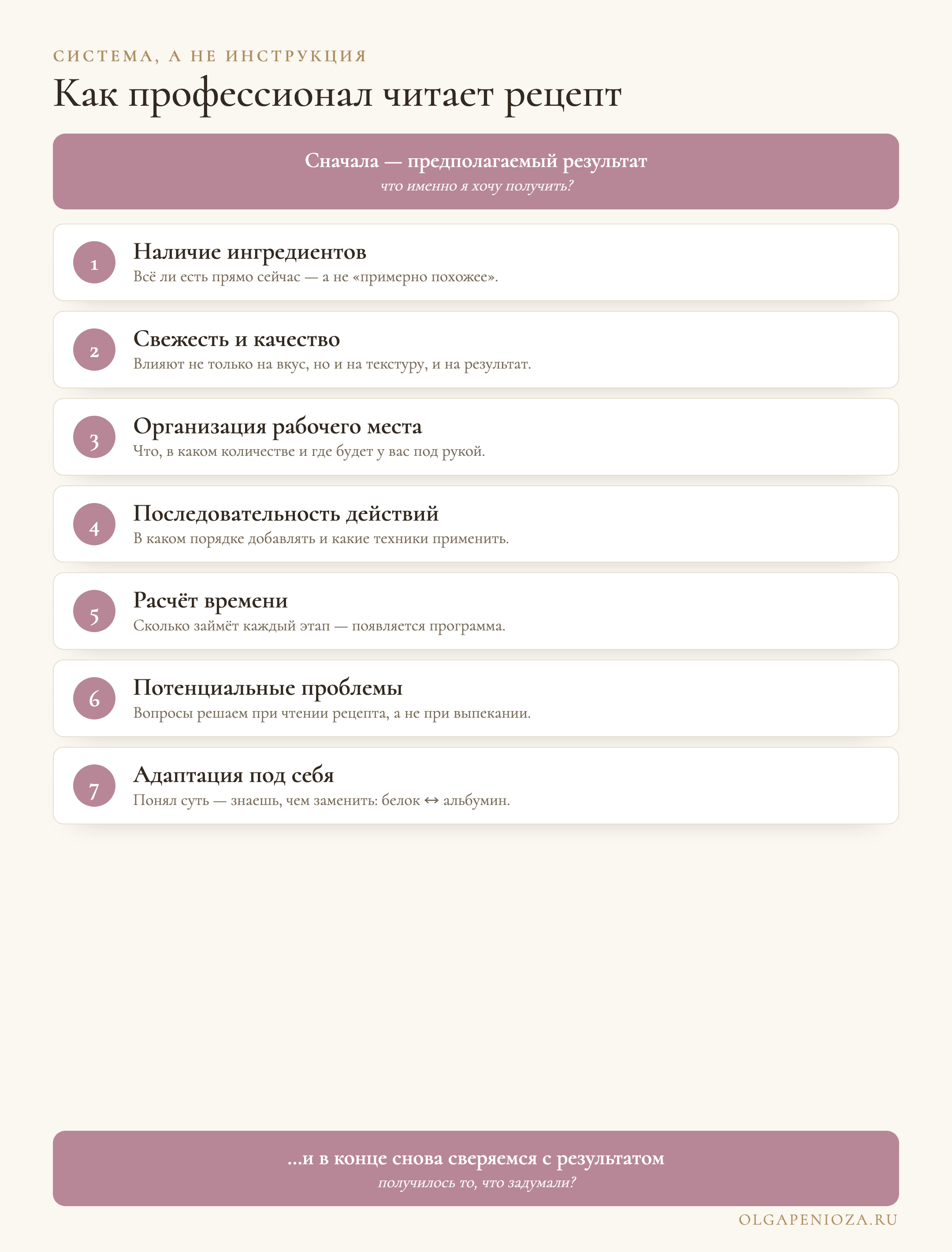
Let us go through it step by step.
1. Ingredient availability
First, you determine whether you have all the ingredients right now. This simple check helps make sure you have everything needed for this particular recipe. Not “something roughly similar,” but everything.
2. Freshness and quality
First you made sure the ingredients are there. Then you check how well they meet your needs. This is straightforward: the quality of the ingredients affects not just the taste, but the texture and the result.
3. Organising your workspace
With this information, you organise your workspace. Knowing which ingredients and tools you will use helps you understand in advance what size and quantity you need, and where everything will be.
4. The sequence of actions
Next, you plan the sequence: in what order to add the ingredients and which preparation techniques to use. Once you have some experience, you begin to understand roughly what you will do with the ingredients just from their appearance and description.
5. Estimating the time
You have a rough idea of how long each process will take, and you get a rough schedule. Of course, it will change depending on which particular egg whites you use, which egg, what kind of mechanism you have, how the whisk fits, and what temperature the eggs were. But you already have a basic parameter to work with.
6. Potential problems
Next, you identify potential problems and difficulties. For example, the recipe says you need albumin, but the difficulty is that you cannot find it. Or you simply do not understand what it is. This creates questions whose answers you need to find while reading the recipe, not while the cake is in the oven.
7. Adapting it to yourself
And the final step is adapting the recipe to yourself when necessary. You do not have albumin? Once you understand what it does, you realise that albumin can be replaced with egg white, and vice versa. That is why we read a recipe carefully and analyse everything it says.
And here I want you to understand why this works. A sponge is a baked product with a particular structure, and that structure is formed by the presence of air. You can introduce air into a sponge in different ways: mechanically, by whipping eggs or fats; chemically, with baking soda or baking powder; biologically, with yeast or a starter culture — and there are modern methods, such as a pressurised siphon. When you keep this in mind, you can already guess what the recipe is about before you read the method, simply by looking at the ingredients. If there is baking soda or baking powder, that is chemical leavening. If there is yeast, it is biological. If there is neither, the recipe is about mechanical whipping. That is what it means to “see more than what is on the surface.”
One word can mean several forms: the story of the egg, egg white, and albumin
Now let us talk about why understanding matters more than repeating. Take the simplest word in a recipe: “egg.”
Looking at a recipe, you may see “egg,” “egg white separately,” or “yolk separately.” And each of these words can refer to more than one form.
- Egg — an egg in its shell; pasteurised egg from a bottle; or a dry powder that needs liquid, specifically water.
- Egg white — egg white from an egg; pasteurised egg white; or albumin, a dried egg powder intended for whipping. And this is important: some albumins are intended not for whipping but for forming a structure — they do not whip. You simply need to read what is written on the label.
- Yolk — from an egg, pasteurised from a bottle, or dry, which you reconstitute. Unlike egg white, which needs a fat-free liquid, yolk can also be reconstituted with milk.
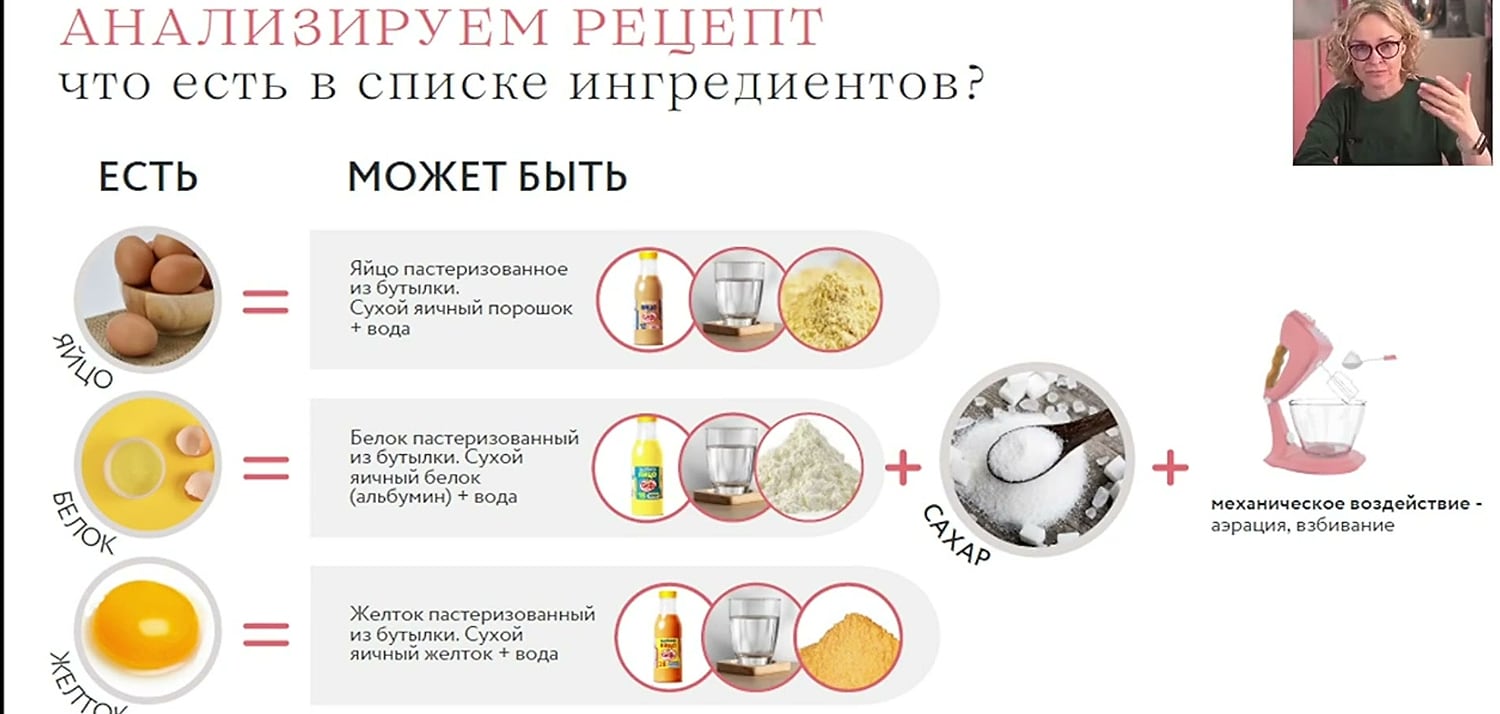
And this is the key detail that separates understanding from memorisation. Egg white does not whip in the presence of fat. That is why egg white is reconstituted only with a fat-free liquid and enough water. If you do not know this, you will blindly follow the letters of the recipe and not understand why the foam will not stand up. If you do know it, you look at “pasteurised egg white” or “albumin” and those words no longer scare you. You understand the task each one performs.
This also answers a common question: can egg white be replaced with purée? No, it cannot. Purée does not contain enough of the right kind of proteins to form a structure. Air is formed, but it is held in place by a protein structure. Without proteins, there is nothing for the water to hold on to, so there will be no structure.
With a strong theoretical foundation, serious mistakes can be avoided. You can understand what can replace an ingredient and get a stable result. Understanding the process is the foundation of everything.
How to spot an “impossible” recipe
This is where it all leads. When you have a system in your head, you can immediately filter out strange recipes even while scrolling through recipes online. You look at the ingredients, you look at the method, and you understand: “No, that cannot be right. That does not work.”
You see a sponge in a photograph and understand that it is impossible to achieve it using that method. Simply impossible.
For example, if someone tells you that they whip any eggs, any egg whites, for a meringue roulade, add no starch, and still get a tall sponge with clearly visible pores, there is definitely something going on. A structure of that height is impossible with ordinary store-bought eggs. Either a substantial amount of something that builds structure has been added, or something else must be forming that structure. Once you know this, you can approach the question critically: analyse it and draw your conclusions.
And here is the reverse rule about substitutions. Directly leaving out an ingredient can have a fatal effect on the sponge’s structure. Replacing an egg with, say, a banana is not a replacement in the full sense. You need to understand what exactly the egg is doing in this particular case. If the egg is a structure-building element that creates a framework through its proteins, a banana definitely will not replace it. But if it is a cake-like mixture that is leavened with chemical raising agents, the situation is different.
It is like a puzzle: if one piece has been damaged a little, you need to make up for that part — but in a way that allows the whole picture to come together. A substitution must have logic, and it must make sense.
Meringue — the foundation everything rests on
And since we have been talking about whipping throughout this whole conversation, I will say it directly. I believe that if you do not know meringue, you know nothing about pastry. Nothing at all. Because it is the foundation. Everything else we cover still comes back to these elements. Even if you are not whipping an egg, you are still actively working with it — and you need to understand what an egg is and what function it performs.
Meringue is the foundation of your sponge’s structure. It is the building material that supports everything else you do and holds it all together — the nuts, the filling, everything else.
And it is not whipped the way many people think. The task is not to tear the proteins apart and turn them into a shaggy foam. The task is to let them stretch, unfold, and form new bonds. That is why meringue takes fifteen minutes to whip, not three, as mixer advertisements cheerfully promise. Finished meringue has fine pores, holds a “beak” like shaving foam, and is not loose. Loose meringue can look over-whipped, but in fact it is underwhipped: the distances between the proteins are too large. And keep in mind — meringue does not fall out of the bowl when it is two-thirds ready, so “it does not fall out” does not yet mean “it is ready.”
What to remember
Today we talked not so much about a recipe as about how to structure the information you receive. Let us gather the main points:
- A recipe is an idea, not a verdict. A map, not an order. Understand the idea, and you can take different routes.
- You should have a plan — and an expected result — before you pick up the mixer. The expected result dictates the set of actions you take.
- Read systematically: ingredient availability → quality → workspace setup → sequence → time → potential problems → adaptation. The question “what do I actually want to get?” closes this system at both the top and the bottom.
- One word can refer to several forms. “Egg,” “egg white,” “albumin” — learn to see what task the ingredient performs instead of memorising the letters.
- When you understand structure, you can filter out “impossible” recipes. “That cannot happen” is not intuition; it is knowledge.
- Meringue is the foundation. If you do not know it, you do not know pastry.
Write down this system for examining recipes and make this step-by-step approach your rule — use it for any process. Believe me, it makes life much easier. Over time, it happens automatically. You do not even notice that you are doing it, and it becomes the foundation of your thinking. Then you cannot be caught out. You will not find yourself facing an impossible task or at a loss — you will simply understand what needs to be done.
And do not think of all this as a limitation or a burden. Think of it as a magic wand. Then things will work out more easily, which means you will enjoy what you are doing. And that is very, very important.